
By: Sam Ross
Edited by: Victoria Percival
While I can’t pinpoint the exact moment I learned about the Holocaust, I know it was formally introduced to me in an educational setting during a discussion on Anne Frank in the second grade. When I first heard the details—presented in a much gentler way than in my later education—I remember wondering how so many people could turn a blind eye to the systematic persecution and murder of nearly six million Jews by the Nazi regime and its collaborators. In my young, childlike mind, it seemed utterly impossible—completely beyond the realm of reality. As I grew older and my education advanced, I had the privilege of speaking directly with Holocaust survivors, gaining a much deeper understanding of the tragedy. Yet, despite this, I still struggled to grasp how the rest of the world could allow the oppression of the Jewish people to escalate so quickly and violently.
I used to think of the atrocities that occurred during the holocaust—which took place between 1941 and 1945—as unimaginable in today’s world. But witnessing how easily people today turn on the Jewish community and defend blatant acts of antisemitism has given me a new perspective. It’s made me realize just how fresh the wounds of the past still are—and how the attitudes that fueled the Holocaust continue to linger in the present.
One of the main contributors to more recent antisemitic comments is, scarily enough, one of the most powerful men in the world. For years, Donald Trump has invoked stereotypes about Jewish people, making comments about their role in controlling the financial and political system and using language framing Jewish individuals as “brutal negotiators” and “sticking together” for their own self-interest. Unsurprisingly, after Trump took office in 2016 antisemitic incidents—ranging from cemetery vandalism and assaults to harassment and even bomb threats—surged across the United States.
The fact that rapper Kanye West could post such hateful rhetoric against Jewish people—publicly declaring on X, “I’M A NAZI” and “I LOVE HITLER NOW WHAT BITCHES”—and still have countless people praise him as a mastermind and musical genius is deeply unsettling. As a Jewish person, I can’t help but wonder: why does society allow figures like Donald Trump and Kanye West to blatantly perpetuate antisemitic rhetoric? And more importantly, why are people so quick to defend these figures, allowing them to gain widespread influence despite their harmful views?
Jewish people have faced hatred and persecution for centuries, long before the Holocaust. Early Christian interpretations blamed them for the crucifixion of Jesus, leading to their social isolation—a pattern that persisted throughout history. By the 19th and 20th centuries, Antisemitism had evolved into a racial ideology, portraying Jews as an inherently dangerous group. Documents like The Protocols of the Elders of Zion spread false claims that Jewish people were trying to take over the world, while in Russia, the government encouraged violent attacks against Jewish communities. These deep-seated prejudices intensified in the lead-up to World War II when economic crises and political instability made Jews scapegoats for Germany’s struggles. Today, similar patterns of prejudice continue, often reinforced by confirmation bias. Figures like Donald Trump and Kanye West appeal to individuals who already hold antisemitic beliefs, providing them with a sense of validation. When these figures express harmful rhetoric, their supporters may overlook or justify it, prioritizing the feeling that their views are being acknowledged over the reality of the damage such rhetoric causes.
All of this raises an important question: So, what can you do as the reader of this article?
For one, you can be there for your Jewish friends. Be the support system we need. So much of what’s happening in the world today is disturbingly reminiscent of times in the recent past—times when we were persecuted, even killed, simply for our faith.
Don’t blindly support artists like Kanye West or share infographics on Instagram that may spread harmful messages about our community. You can educate yourself on the history of antisemitism and spread that knowledge with others, speak out against the hate you see. Take a moment to check in on us. I promise you, so many of us are struggling with the mass publication of hate and the blind following of it. Your awareness, your solidarity, and your willingness to listen can help dismantle hatred and create lasting change.
References:
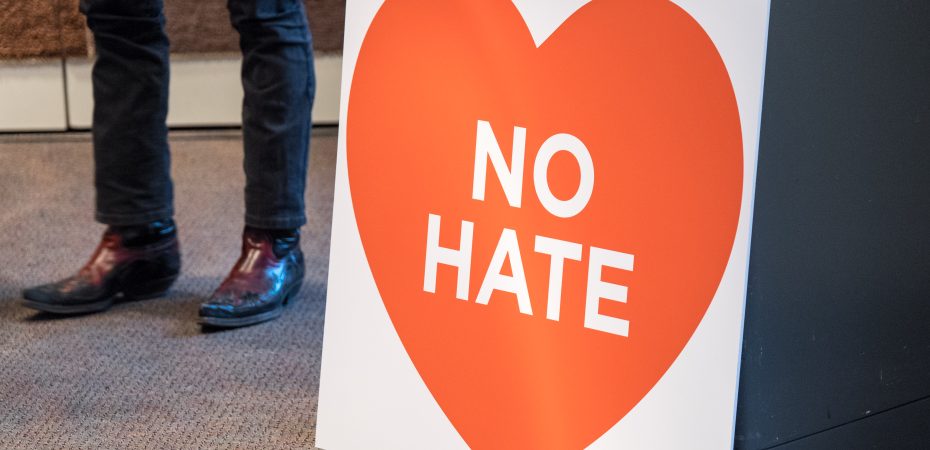
Image Source: Rüegge, Stefan. Abschlussevent der No Hate Speech Kampagne. 14 Mar. 2015, http://www.flickr.com/photos/sajv_csaj/16767822830
Blake, Aaron. “Trump’s Long History of Trafficking in Antisemitic Tropes.” The Washington Post, 17 Oct. 2022, www.washingtonpost.com/politics/2022/10/17/trump-history-antisemitic-tropes/.
John, Tara. “Anti-Semitic Attacks in the U.S. Increased by 86% at the Start of 2017, Report Says.” Time, 24 Apr. 2017, https://time.com/4752446/anti-semitic-attacks-spike-anti-defamation-league/.
Image source: Rüegge, Stefan. Abschlussevent der No Hate Speech Kampagne. 14 Mar. 2015, Flickr, www.flickr.com/photos/sajv_csaj/16767822830.
United States Holocaust Memorial Museum. “Why the Jews? History of Antisemitism.” Holocaust Encyclopedia, United States Holocaust Memorial Museum, https://www.ushmm.org/antisemitism/what-is-antisemitism/why-the-jews-history-of-antisemitism.