
By: Leo Kristal-Polci
Edited by: Emmet Paradis
Emily Ratajkowski probably isn’t the name you would expect to see in the first line of an article on city-level voting practices. On June 24th, however, the American model posted a video to her Instagram account that made her especially relevant to the world of municipal politics.
In the video, she stands with New York State assemblyman and NYC mayoral hopeful Zohran Mamdani, urging New Yorkers to get to the polls to vote in the Democratic primary. In and of itself, this is hardly noteworthy. Politicians of all orders of government often use celebrity endorsements to sway target fan bases, and the votes they represent, in their favour. What is of particular interest instead is the language that Ratajkowski used in making her appeal: “The last mayoral race was decided by 7000 votes. That means that your vote really matters.” These two simple sentences are emblematic of the broader approach Mamdani has taken to stir voters off their couches and towards polling stations: instead of simply emphasizing the importance of the issues at stake, he emphasizes the importance of the voters themselves.
Mamdani’s campaign has often repeated talking points that frame November 4th’s election as a close-fought battle, sensitive to every vote cast one way or another. The message is clear—voters should recognize the power they hold, such that it would be foolish not to show up and register their preference at the polls.
While most politicians employ this tactic to some degree, Mamdani has made it a prominent feature of his campaign, both in the run up to his 12-point victory over Andrew Cuomo in the Democratic primary and now, in his quest to become New York City’s next mayor. With opinion polls suggesting Mamdani holds a double-digit lead heading into the election, his approach seems to be paying off.
In assemblyman Mamdani’s case, rallying voters to the polls is, of course, done with partisan motives, but it’s easy to see the implications this kind of strategy might have in inspiring an increase in gross voter turnout.
In a specifically Ontarian context, turnout in municipal elections has long lagged behind that of provincial and federal elections. Whereas the turnout in Canada’s last federal election was 69.5% and Ontario’s most recent provincial turnout was 45.4%, the average municipal turnout in Ontario in 2022 was only 32.9%. This is down from 2018’s already low figure of 38.3%. Given that turnout is often taken as a signal of the health and vitality of a democracy, this has been understandably regarded as a concerning trend.
If municipalities themselves could implement substantial institutional reforms to lend real weight to the rhetoric of politicians like Mamdani, the potential for increased voter participation is huge. In other words, if the feeling of having an empowered vote is more than just a feeling—if it becomes a fact—voters might be coaxed back to the ballot box.
The idea of offering voters greater sway over results as a means of getting them to the polls was picked up on by scholars as early as the 1960s. In their investigations surrounding what drives eligible voters to actually cast their ballots, professors William Riker and Peter Ordeshook proposed a revised version of Anthony Downs’ rational choice formula to model the decision-making process.
The formula identified four main variables that interact to produce the reward that voters receive from voting: the differential benefit of the success of their preferred candidate over a competitor, the probability that one’s vote would be instrumental in bringing about said benefit, the cost incurred by the voter in the process of voting, and the mental and civic satisfaction the voter receives from voting. The model assumes that by lowering the value of the cost term or by raising the values of the other three terms, policymakers could move the needle on the voter reward calculus in a way that would get more people casting ballots.
Yet, of the two variables most responsive to institutional change, voter cost and probability of votes mattering, far more attention has been paid to the former, leaving the latter’s potential largely untapped.
Where early voting periods, mail-in ballots, and convenient local polling stations have all been explored by various municipalities to reduce voting barriers, strategies to raise individual voter influence have been all but overlooked. Political scientists like Emory University’s Bernard Fraga have noted that this approach is misguided; it seems that focusing on reducing voter costs and barriers is far less effective at mobilizing voters than focusing on elevating individual perception of voter influence.
One way of creating institutions that put this philosophy at the forefront is by ending the practice of large metropolitan amalgamation. In the past 30 years, the cities of Toronto, Ottawa, Hamilton, and Sudbury have all absorbed smaller, formerly independent municipalities into their own city governments.
Election statistics show that smaller Ontario municipalities tend to have higher voter turnout than their larger counterparts. In fact, while average turnout in municipalities as a whole dropped over 4% between the 2018 and 2022 elections, it actually rose in municipalities with under 2500 citizens. This climb was particularly pronounced in communities under 1000 people, where the figure rose by roughly 8% in the same time frame.
By amalgamating these areas, citizens who, given the size of their communities, previously considered themselves consequential electors, suddenly found themselves lost in the crowd. Putting this practice to bed would protect faith in municipal elections from degenerating further.
A more proactive option might be to appeal to the provincial government for permission to change municipal electoral systems from the standard single-member-plurality model (first-past-the-post), to a majority ranked-choice voting model. SMP tends to lead to electoral outcomes where the winning candidate may not have a majority of support, and where voters who do not support them feel that their vote has been wasted. By allowing voters to rank candidates, they are ensured that even if their preferred candidate does not win, they are still actively influencing who ends up holding office.
Relatedly, the danger of acclamations cannot be overstated. When a municipal politician runs in an election unchallenged, it is obvious enough that citizens are powerless to influence the outcome and feel no need to head to the polls. More interesting, however, are the effects that acclamations have on voter turnout for related offices. Evidence from Ontario shows that turnout is 13% higher in municipalities with no acclamations than it is in municipalities where more than half of offices are acclaimed. This statistic seems to indicate that offices that are facing acclamations “bring down the rest” when it comes to voter turnout. Taking measures to incentivize running for municipal government thus becomes a crucial part of the fight against dropping voter turnout.
There are doubtless other approaches to dealing with the issue of democratic participation in Ontario’s municipalities, but regardless of methods, one thing is clear: future efforts should target the empowerment of individual voters. By the time this article is released, New Yorkers will have returned a verdict on Zohran Mamdani and his campaigning strategies, a verdict that Ontario’s policy makers would be advised to study carefully ahead of next year’s municipal elections.
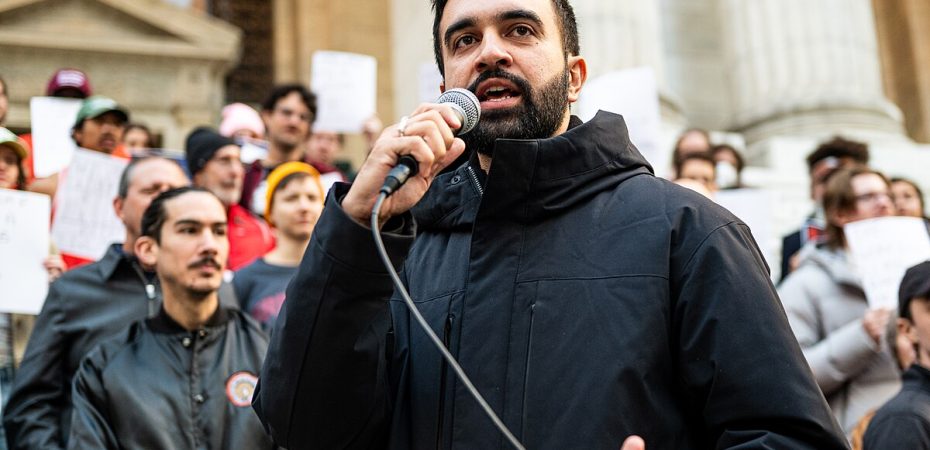
Image Citation: He, B. (2024). Zohran Mamdani at the Resist Fascism Rally in Bryant Park on Oct 27th 2024 [Photograph]. Wikimedia Commons. https://commons.wikimedia.org/wiki/File:Zohran_Mamdani_at_the_Resist_Fascism_Rally_in_Bryant_Park_on_Oct_27th_2024.jpg

References:
AMCTO. (2022). AMCTO 2022 Post Election Survey Report. AMCTO. https://www.amcto.com/sites/default/files/2024-02/AMCTO%202022%20Post%20Election%20Survey%20Report.pdf
CBC News. (1999, December 7). Opposition to Amalgamation. CBC. https://www.cbc.ca/news/canada/opposition-to-amalgamation-1.169484
Elections Canada. (2025, April 29). UPDATED: The 45th Federal Election by the Numbers. Elections Canada. https://www.elections.ca/content.aspx?section=med&dir=pre&document=apr2925&lang=e
Fraga, B. (2018). The Turnout Gap. Cambridge University Press. https://doi.org/10.1017/9781108566483.001
Madonik, R., & Farooqui, S. (2017, January 1). 19 years ago, Toronto’s six boroughs amalgamated. Toronto Star. https://www.thestar.com/news/gta/19-years-ago-toronto-s-six-boroughs-amalgamated/article_d0fb7618-907a-554d-974c-674dd8caa26d.html
Ratajkowski, E. (2025). [Video with Zohran Mamdani urging people to vote in Democratic primary]. Instagram. https://www.instagram.com/reel/DLSHcLUsPnX/?hl=en
Riker, W., & Ordeshook, P. (1968). A Theory of the Calculus of Voting. American Political Science Review, 62(1). https://www.cambridge.org/core/journals/american-political-science-review/article/abs/theory-of-the-calculus-of-voting/500608E51991E92AC96EB6860F1192CA
Rodrigues, G. (2025, February 28). Ontario election: Voter turnout higher than expected in 2025, early data shows. Global News. https://globalnews.ca/news/11052258/ontario-election-2025-voter-turnout/
Soler, C. (2025, October 27). Who Is Ahead in the NYC Mayoral Race? Latest 2025 Election Polls. The New York Times. https://www.nytimes.com/interactive/polls/nyc-mayoral-election-polls-2025.html