By: Valerie Kniazeva
Edited by: Natalie Cowan
We live in an era of endless division. From polarized politics to curated realities online, the boundaries between “us” and “them” have never become so expansive. Misinformation spreads faster than dialogue, and blame farther than empathy. As education systems race to keep up with digital and social change, one question arises amongst the rest: can schools heal division?
Peace education gives educators hope, however, not through our dominating metrics and assessment practices. Across Canada, teachers have spoken out about how standardized testing reveals limiting results of learning, pushing towards new methods of assessment and achievement measurement. As the Elementary Teachers’ Federation of Ontario discusses, this regime “dehumanizes” education by reducing complex human growth to numbers and rankings. Similar concerns echo in Psychology Today, which argues that high-stakes testing erodes creativity, empathy, and community, qualities which are pillars and foundational steps towards peace.
Peace education comes from a novel direction. As scholars Edward Brantmeier and Monisha Bajaj describe, it seeks to build “comprehensive peace” by addressing every layer of violence, which can be characterized into three levels: direct, structural, and cultural. Violence does not have to be something physical; it is also the creeping silence that excludes, the bias embedded in curricula, and the online opposition that replaces understanding with hatred and mockery. When education is rooted in empathy and justice, forces such as these can be easily dismantled and disarmed.
In a world consumed by information overload and digital misinformation, peace education also becomes media education. Through programs and research such as Peace Learner, educators can use activities and resources in their classrooms rooted in emotional intelligence, emphasizing self-regulation, perspective-taking, and nonviolent communications. Such skills become crucial in our current society, especially for developing young people, who are highly influential and are now growing in a technology and media-oriented world. They teach them to recognize digital and emotional manipulation tactics that are used in media and politics around the world. Helping students learn to pause before sharing, to question sources, even when they appear to be credible, and to humanize those who they disagree with are all examples of peacebuilding.
Through the works of Brantmeier and Bajaj in the Peace Education Praxis, we see that peace education not only becomes abstract idealism, but practical realities. Schools such as New York City’s Humanities Preparatory High School have diverged from standardization, having admission exams be replaced by portfolio assessments, catering and engaging with students through reflection, collaboration, and problem solving. Additionally, integrated bilingual schools, such as those in Israel, work to pair both Jewish and Arab teachers in the same classrooms, allowing them to challenge cultural biases through shared storytelling and interpersonal relationships. With these institutionalized practices, peace education builds solid ground to show that empathy in school and assessment can make a difference and help close gaps. The question remains whether larger systems are willing to find ways to measure it or not. Looking at Canada, even with the conversations and decline of standardized testing, resistance is met with anxiety about accountability. Yet perhaps it is the definition of accountability that can in turn be challenged. With academics being so heavily reliant on data and grades, what if more of an emphasis was shifted towards a collective approach, shifting from the individual to a larger cooperation? What would school boards and national ministries discover if we explored inclusion, cross-cultural understanding, and digital civility as rigorously as math scores? The answer is not to completely scrap standardized testing, but to explore new forms of assessment, and track additional social factors outside of academics, when it comes to student life and culture.
However, education is not limited to K-12 classrooms. Universities and post-secondary institutions push debates and analysis, which can further build polarization, rather than dismantling it, resulting in competition and high emotions. Instead, professors and students can experiment more with deliberative circles, reflective journaling, and co-created curricula. These approaches would position students more as agents of inquiry and change, rather than adversaries in a race. Brazilian educator Paulo Freire once said how “Education must be an act of love, and thus, an act of courage,” using his participatory learning theories to see students as empty containers, filled with knowledge that can help them find the truth. Post-secondary should not be a performance of expertise, but a place where young adults can learn to think critically about our world, to problem solve, and learn how to always continue learning from others and the world around us.
At its heart, peace education is political. It insists that schooling can be a site for human connection in a torn world. It asks policymakers to look beyond data dashboards and test results, and to see education as a living ecosystem of relationships. When students learn to listen deeply, when teachers are empowered to facilitate empathy, and when institutions value dialogue as much as delivery, schools can indeed begin to heal division.
Peace education is not a fast process and can at times seem intangible. But, in an ever-evolving world, the stakes couldn’t be higher to start working towards a more peaceful future. Peace cannot be downloaded or standardized; it must be practiced, day after day, in the spaces where young people learn both who they are and who “the others” might be. If education was once divided by ranking, perhaps it can now reconcile through connecting.
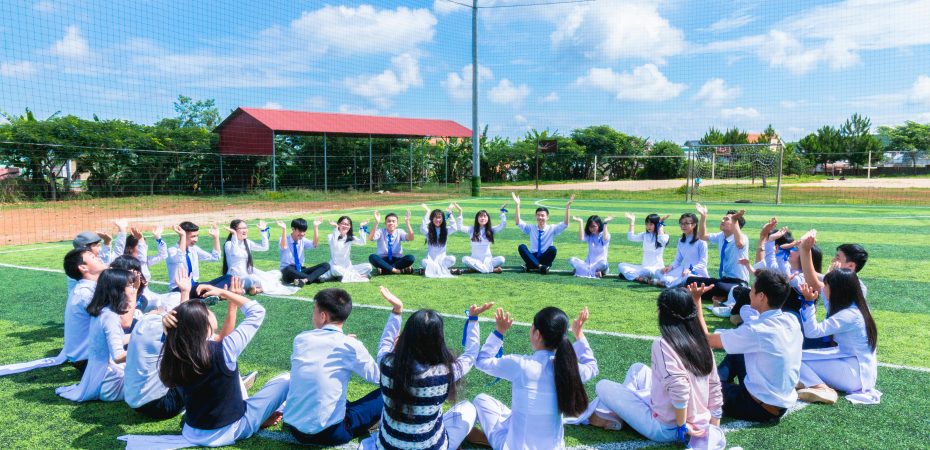
Image Source: Hinh, C. (n.d.). People at a school sitting outside on the grass doing a morning activity [Photograph]. Pexels. https://www.pexels.com/photo/people-sitting-on-green-lawn-grass-while-doing-hands-up-at-daytime-1164572/
References:
(n.d.). About. https://www.edwardjbrantmeier.org/
Brantmeier, E. J., & Bajaj, M. (2014). Peace Education Praxis. In Educating about social issues in the 20th and 21st centuries – Vol 4: Critical pedagogues and their pedagogical theories (pp. 139-159). IAP.
(n.d.). Dr. Monisha Bajaj. https://www.monishabajaj.net/
Freire Institute. (n.d.). Paulo Freire. https://www.freire.org/paulo-freire
Gray, P. (2022, November 17). Standardized Testing and the Destruction of Education. Psychology Today. https://www.psychologytoday.com/ca/blog/freedom-learn/202211/standardized-testing-and-the-destruction-education
(n.d.). Home. Elementary Teachers’ Foundation of Ontario. https://www.etfo.ca/
Lewis, S. (2022, April). EQAO Standardized Testing is the Barrier. ETFO Voice. https://etfovoice.ca/feature/eqao-standardized-testing-barrier#:~:text=Rehumanizing%20math%20and%20language%20experiences,of%20Elementary%20Teachers%20of%20Toronto
(n.d.). Peace Learner. https://peacelearner.org/
Tickle, L. (2016, July 12). Healing division in schools: The lessons from Ireland. The Guardian. https://www.theguardian.com/education/2016/jul/12/schools-eu-referendum-racism-education-uk
Zwaagstra, M. (2022, March 29). Standardized testing on the wane in Canada, limiting ability to assess classroom performance. Fraser Institute | Fraser Institute.