By: Jessica Enns
Edited by: Olivia Yzerman
In the past five years, the topic of literary censorship has been at an all-time high. Conversations have been flowing about which texts parents, educators, and librarians believe students should be allowed to read, and what should be completely off limits. As I began to look more closely at this issue, I noticed that many of these debates surround a common sentiment of needing to “protect our children.” Voiced by communities of adults concerned for their youth, this statement has become the justification for limiting access to books (Brooks, 2022). This claim led me to a further question: what are children being protected from, and at what cost?
Censorship is not a new phenomenon. Historically, it has taken various forms, with concerns that arise most notably in North America around religion, obscenity, and political control. Within these categories lies a shared idea: that the uncensored works contain themes adults believe are unsafe or unsuited for children.
Of course, there are legitimate concerns surrounding safety and age appropriateness. The argument against book banning does not state that every book belongs in every classroom. It is understood that some works contain mature content that must be introduced and explored with care. But the recent increase in book banning across North America reveals something entirely beyond age guidelines.
PEN America reports that we are currently facing the highest rate of book bans since the Red Scare of the 1950s. PEN America found these challenges target books with LGBTQ+ characters, racialized protagonists, and other marginalized viewpoints. Yet these challenges are frequently justified by citing “explicit sexual content,” often using scenes taken out of context for their defense. With this action, students are being shielded from personal perspectives and experiences that challenge their own beliefs, which is being expressed as moral protection.
However, censorship goes beyond one side of the political spectrum. While conservative groups have challenged contemporary works with a focus on race and gender, progressives have historically petitioned to remove texts such as To Kill a Mockingbird or The Adventures of Huckleberry Finn due to their racist language. As Art Spiegelman, author of the frequently challenged Maus, said, “It’s not as simple as left versus right. It’s a culture war that’s totally out of control.” Both sides, in their own ways, share the belief that children must be shielded from the complexities of life, while complexity is exactly what they need to learn how to navigate.
Ironically, no amount of censorship can prevent young people from finding information. With a generation that knows exactly how to navigate social media and the internet, students can find more content online than they could in a library or classroom. Banning books doesn’t protect youth from “taboo” themes, but instead limits their intellectual freedom while giving adults the illusion of control. James Turk, the director of the Centre for Free Expression at Toronto Metropolitan University, argues that this movement “grows out of this notion that ‘our kids are our property.” Turk believes, “It’s a very backward-looking, reactionary way of understanding how children learn.”
The consequences of censorship go beyond the classroom. When students are denied access to diverse stories, they lose the ability to develop empathy, curiosity, and independent thought. David A. Robertson, a Canadian author, says that books can be “mirrors, windows and sliding glass doors… a reflection of a reader, a glimpse into a life different from one’s own and an opportunity to step into a character’s shoes.” Without that access, the classroom is at risk of becoming a space of comfort rather than discovery.
The very structure of education is not built on agreement. Learning is not about confirming what we already know, but about challenging and expanding our beliefs. Education is about access and providing students with an opportunity to explore perspectives and experiences that they may never encounter outside the classroom. When we censor literature, we are denying students the function of education, which is to make sense of the world through exploration and critical thought.
To encourage censorship is to encourage the notion that difficult ideas harm rather than educate. Students who are able to question and analyze texts are better prepared to engage in real-world challenges and to think about the information that surrounds them. In a time where critical thinking is in decline, these skills must begin in the classroom and cannot be lost there too.
Conversations about content sensitivity and age appropriateness must happen, but they must occur in a space of trust – for educators, for literature, and the young people themselves. Protecting youth is an understandable goal. Control is not. The difference lies in whether we want to help students navigate difficult realities or prevent them from facing those realities entirely.
To truly “protect our children,” we must provide them with the freedom to read, to question, and to think independently. Shielding them from complexity does not ensure their safety– it only leaves them less prepared for the world they will inherit.
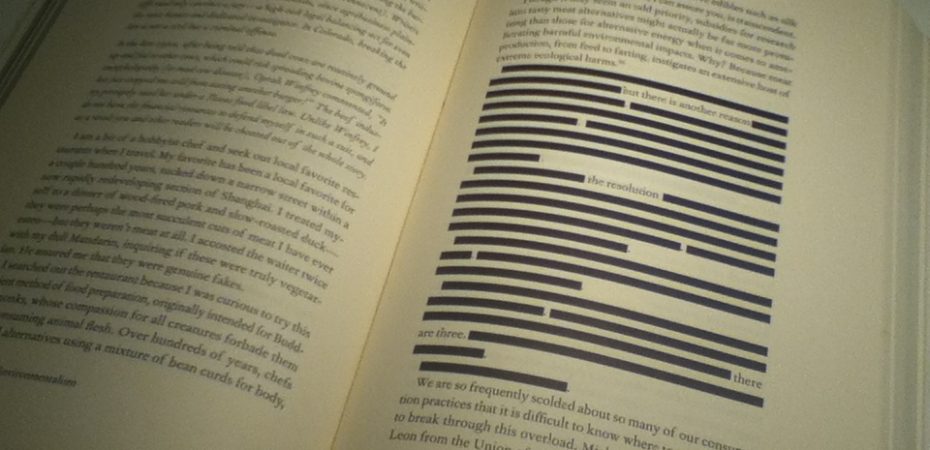
Image Citation: Wikimedia Commons. (2012). Censored section of Green Illusions by Ozzie Zehner [Photograph]. Wikimedia Commons. https://commons.wikimedia.org/wiki/File:Censored_section_of_Green_Illusions_by_Ozzie_Zehner.jpg.

References:
Armitstead, Claire. (2022, March 22). ‘It’s a culture war that’s totally out of control’: the authors whose books are being banned in US schools. The Guardian. https://www.theguardian.com/books/2022/mar/22/its-a-culture-war-thats-totally-out-of-control-the-authors-whose-books-are-being-banned-in-us-schools.
Bowden, Olivia. (2025, August 27). Rightwing ‘parents’ rights’ groups gain ground in Canada as Alberta book bans target LGBTQ+ titles. The Guardian. https://www.theguardian.com/world/2025/aug/27/alberta-book-ban-canada-parents-rights-groups.
Brooks, Libby. (2022, March 31). ‘Out of touch’: children’s authors describe increasing censorship of books on diversity. The Guardian. https://www.theguardian.com/books/2022/mar/31/childrens-authors-describe-worrying-trend-of-censorship-of-books-on-diversity.
Canadian School Libraries. (2023, May 24). CSL Statement: Book Challenges and Censorship in Canada’s School Libraries. CSL. https://www.canadianschoollibraries.ca/wp-content/uploads/2023/05/CSLstatement_BookChallenges_Censorship_May2023.pdf.
PEN America. (2023, July 13). Manuscripts Don’t Burn: a Timeline of Literary Censorship, Destruction, and Liberation. PEN America. https://pen.org/censorship-history-book-bans/.
Wong, Jessica. (2024, February 21). Calls to ban books are on the rise in Canada. So is the opposition to any bans. CBC. https://www.cbc.ca/news/canada/freedomtoreadweek-schools-1.7106913.