
By: Sam Ross
Edited by: Lauren Breen
As a 21-year-old, I have started to learn a few things about what exactly makes me, me. I know that I have the biggest sensations of joy whenever I make people around me laugh. I know that I love to sing and express myself through music. I know that I am passionate about many global issues. I enjoy voicing my opinions, even if I know some might disagree with me. I know that I love to dance, take pictures, and be my most eclectic self with my friends by my side.
But a large part of what makes me, me, is that I am a woman.
In Afghanistan, this fact alone would prevent me from doing every single one of these joyous things. This is the harsh reality for all the women whose actions are dictated by the Taliban’s oppressive rule.
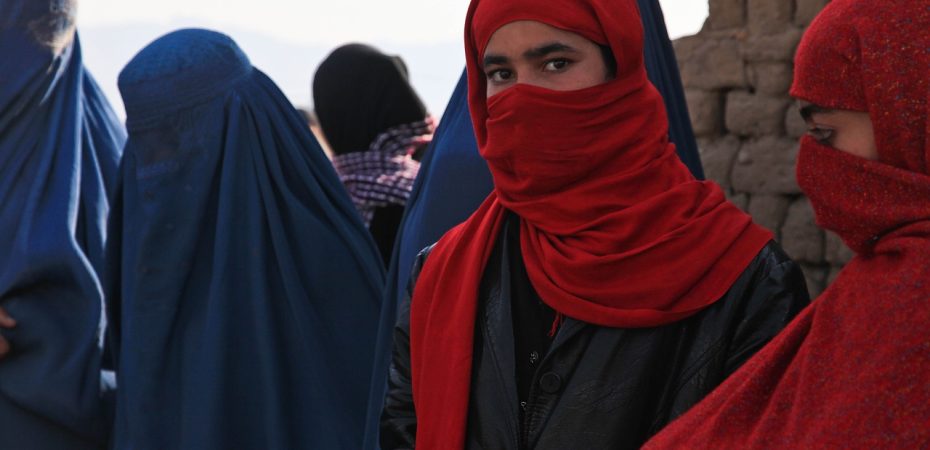
The Taliban is an extremist Sunni Islamic fundamentalist movement that controlled Afghanistan from 1996 until 2001 and, unfortunately, gained complete power again in 2021.Under their control, women are stripped of their rights and denied any form of pleasure. The laws serve as rigid barriers, separating them from autonomy and agency over their own lives. These laws include, but are not limited to, the following: the disallowance prohibition of women going anywhere in public spaces without the presence of a male relative, the banning of girls from attending secondary schools, and the enforcement of a strict dress code including burqas that reveal only their eyes if they do leave their homes.
The most recent law enacted in August of this year completely forbids women from speaking outside of their households. This means that, even in their already dehumanizing situation—having to leave their homes fully covered from head to toe and accompanied by a male relative acting as a babysitter—they are not allowed to say anything.
Women are not to be seen nor heard from.
These laws, if found broken are punishable by public beatings and torture, long-term imprisonment, and execution. Despite awareness of the consequences, there have been many brave women who have protested this injustice. Such is the case with Parwana Ibrahimkhail Nijrabi, who protested the power of the Taliban, but was arrested for crimes relating to “promoting immortality.” She was arrested and tortured from the moment she was detained, threatened with a gun to her head and told she would be killed if she did not comply. She was fed food containing nails, and taunted with death threats, Thankfully, due to intervention by human rights organizations, she was released and able to flee Afghanistan.
“But what am I supposed to do about this?”
This is always the question that arises when in discussions about these issues . We get uncomfortable. We cannot fathom our reality, so we push away these stories of women struggling for survival, living a meaningless existence, and being tortured for wanting otherwise. We reassure ourselves by remembering they are on the other side of the world and this situation is out of our control. And in many aspects, it is. But in many, it isn’t. Why is it that other causes receive substantial attention and news coverage, yet when I was researching for this article, I found little information?
Not to mention, in the recent presidential campaign in which many different conflicts were brought up, why did neither party address this glaring violation of human rights?
We need to not shy away from the reality of these injustices. We need to accept that this could be any one of us as women because, on a basic surface level, there is no difference between me and a 21-year-old in Afghanistan. Yet, by some luck in my favor, whatever creates our fate, I ended up here, getting to study my passions and express myself wholeheartedly while these women are imprisoned. We need to stand together as women who are in a privileged position and do something, do anything. Treat these women the way you would treat your female friend, mother, or sister.
Support women’s organizations that send assistance for women in Afghanistan, both those currently living there and those who have sought refuge. Linked here is a list of websites that are helpful directly for this cause.
You can also increase your own education on this topic, as well as work to educate others by using your platform and resources to raise awareness. Even an action as simple as sending an article to a family member, can help to bring attention to the problem and inspire more people to help. While we as individuals may not be able to do much alone, the more people who know about the problem, the more we can work together to find a viable solution.
We need to be the voice for the women who do not have one anymore.
References:
“Instability in Afghanistan | Global Conflict Tracker.” Council on Foreign Relations, Council on Foreign Relations, 1 July 2024, www.cfr.org/global-conflict-tracker/conflict/war-afghanistan.
Nowrouzi, Mahjooba. “Afghanistan: What Happened to the Women Who Protested against the Taliban?” BBC News, BBC, 14 June 2024, www.bbc.com/news/articles/c9xxklr0070o.
Safi, Mariam, and Orzala Nemat. “New Morality Law in Afghanistan Is Not Just Silencing Women’s Voices: It’s Gender Apartheid.” ODI, ODI Global, 11 Oct. 2024, odi.org/en/insights/new-morality-law-in-afghanistan-is-not-just-silencing-womens-voices-its-gender-apartheid/.
“Women’s Rights in Afghanistan.” 9 Facts on Women’s Rights in Afghanistan, Medica Mondiale, medicamondiale.org/en/where-we-empower-women/afghanistan. Accessed 10 Nov. 2024.
Image Source: ArmyAmber, https://www.needpix.com/photo/45887/afghanistan-girl-burqa-ceremony-bee-keeping-women-free-pictures-free-photos-free-images